
AI and the Inevitable Ruination of Genre Fiction
I’ve been an author for over 20 years, and I obviously have a long history of writing fiction and non-fiction in the pre-AI era. Yet, I get comments on my ads and posts every week, accusing me of using AI to write my novels.
Some actual comments I’ve received on my ads and posts recently:
- “AI slop.”
- “AI-generated garbage.”
- “Why do you keep using fake Kindle reviews to promote your books?”
And so on. Most of these comments have been directed at my superhero fiction series, as the ads I’m running are targeted to a broad audience comprised of comic book readers, superhero movie fans, and people who enjoy superhero fiction.
Casting a broad net in your marketing inevitably means you’ll attract trolls. That’s just the nature of the game. Yet, lately I’ve observed that this activity goes beyond the usual vitriolic comments randos leave on my ads and posts.
You know what’s funny about these comments? None of my books were written with AI. Zilch. Zero. Zip.
Additionally, to date, none of my covers have been produced using AI (I say “to date” because I won’t rule out the possibility that I might use AI-generated artwork on a cover in the future).
And of course, every review I use in my ads and marketing is a legitimate reader review, with most of them coming from my beta reading team (ARC readers).
Thus, my typical response to these verbal attacks is to laugh first, then delete the comment and block the person who posted it. Despite my ability to shrug them off, it does beg the question as to why such comments have become more frequent recently.
The answer? I believe it’s a combination of the average person’s irritation at AI seemingly taking over everything, and the fact that most people are not very good at spotting AI-generated content.
Yet, we can’t wholly blame the end-user. Their frustrations are genuine and not without cause.
The Enshittification of Literature
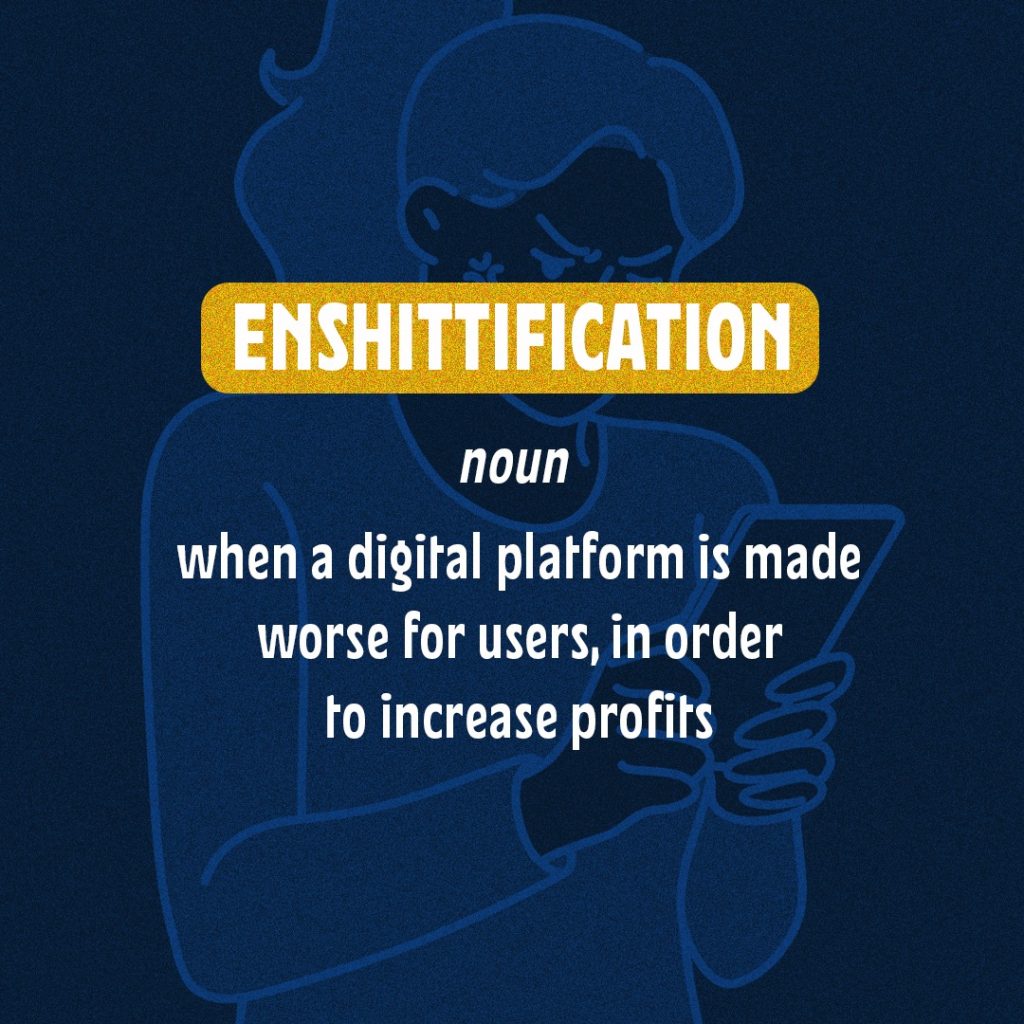
Let’s face it, enshittification (as coined by Cory Doctorow) is everywhere. Much as I disagree with the man’s views on copyright law, he’s absolutely right about how platforms die:
“Here is how platforms die: first, they are good to their users; then they abuse their users to make things better for their business customers; finally, they abuse those business customers to claw back all the value for themselves. Then, they die. I call this enshittification, and it is a seemingly inevitable consequence arising from the combination of the ease of changing how a platform allocates value, combined with the nature of a ‘two-sided market’, where a platform sits between buyers and sellers, hold each hostage to the other, raking off an ever-larger share of the value that passes between them.”
~Cory Doctorow, Wired, January 2023
This has happened to Amazon, Google, and Facebook, and it’s currently happening on the Kindle eBook store due to the massive influx of AI-generated books.
K-Lytics, a well-known compiler of sales and ranking data for the self-publishing industry, recently posted about how this is affecting the ebook market on the Kindle platform:
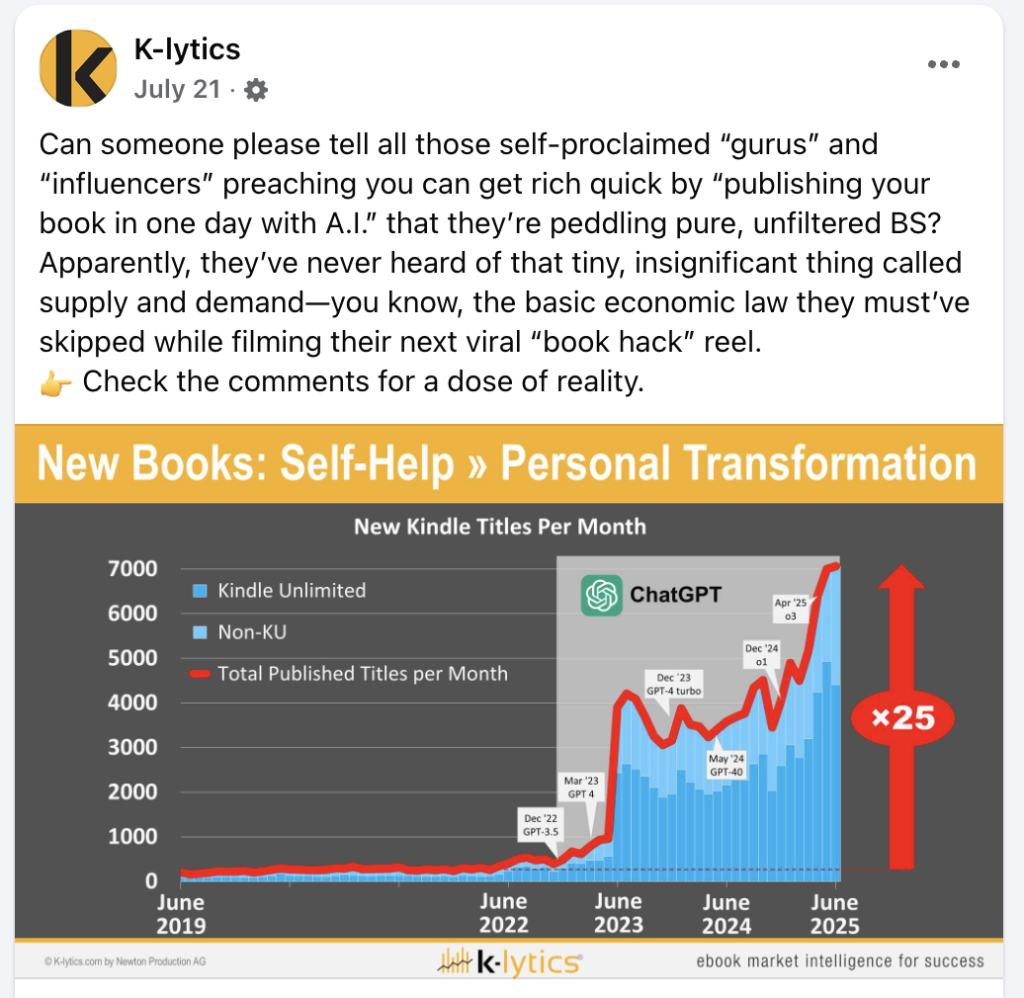
As you can see in the graphic, the total number of titles published monthly in the “Self-Help > Personal Transformation” category on the Kindle store has increased 25 times since the release of ChatGPT to the public.
Alex (the owner of K-lytics) went on to post another graphic illustrating the drop in demand for non-fiction titles on the Kindle platform since the advent and widespread adoption of AI large language models. He based this on the average sales rank of non-fiction and fiction titles.
According to the visual Alex posted, while fiction sales rankings have remained steady, demand for non-fiction titles has plummeted to near-pandemic levels on the platform.
Amazon may be allowing this to happen in its Kindle store because more books mean increased profits overall. Or, they may not have yet developed a suitable method to prevent poor-quality AI-generated books from being uploaded to their store.
Either way, it’s bad for readers, and if it continues, it’ll be detrimental to Amazon over the long haul. If readers cannot easily determine which books contain low-quality AI content before they buy, they’ll eventually lose faith in the Kindle platform overall.
Currently, Kindle Direct Publishing users may opt to identify their works as being AI-generated, but it’s not a requirement. Regardless, Amazon appears to be collecting data on how readers respond to AI-generated books and how that impacts their sales performance.
How they use this data remains to be seen. While they might ban or restrict AI-generated books in the future, I suspect there’s something more sinister coming down the pike (more on that shortly).
Thankfully, it seems this phenomenon is mostly impacting the non-fiction market at the moment. However, that doesn’t mean that poor-quality, AI-written fiction novels aren’t already clogging up the search results on Amazon. Nor does it mean that legitimate working authors aren’t being hurt by these technologies.
This Is Not a New Problem
The Author’s Guild (of which I am a member) reported on the parasitical nature of AI-generated books at length in March of last year. I personally was the target of an early iteration of a similar scam in the nascent days of AI development by Big Tech.
At that time, I’d written and published a non-fiction title that gained significant traction on the Kindle platform. Scammers in a certain “get rich on Kindle” group caught wind of it, and they took my book and ran it through Google’s translation app multiple times, then republished the book on Kindle.
Multiple KDP users did this, and there was absolutely nothing I could do about it as the works they published were (on a surface level, at least) substantially different from my original work. Sales for my book tanked as the market for that topic became flooded with lookalike books, and I lost a significant amount of potential royalty income as a result.
The only good thing that came from that experience was that it convinced me to focus my efforts on writing and publishing fiction. More than a decade later, it appears things have worked out for the better.
However, I wonder how long authors like myself (meaning, those who actually write their own books) will continue to have sustainable careers in the face of the so-called “AI revolution.”
LLMs Are The New Ghostwriter
If you think established authors aren’t already using AI to write books, think again. The romantasy world was rocked by scandal earlier this year when two well-known authors left AI prompts in their books.
You might ask, how does something like this get past the revision and editing process? I would answer that there’s big money to be made in subgenres like romantasy, and the faster an in-demand author releases new books, the more money they make.
Oftentimes, authors release novels with minimal revision and editing, because they’ve learned over time that their audience is more concerned with publishing frequency than quality prose.
Thus, certain authors have resorted to using AI to produce books more quickly, relying on AI tools to ensure the content they produce is free from grammatical and typographical errors.
Yet, this is a familiar pattern. Those in the know are aware that certain popular romance authors quietly maintain a stable of ghostwriters who help them churn out new novels at a breakneck pace.
Now, it appears that LLMs are the new ghostwriters, with the practice having evolved in the race to get the maximum number of titles published to feed an ever more voracious reading audience.
Despite my distaste for these practices, it bears mentioning that I’m not completely anti-AI. In fact, I’ve adopted certain tools for limited use in speeding up day-to-day marketing tasks for my business.
Gazing Into the Abyss: Leveraging AI Without Losing One’s Soul
Considering the topic of this post, I would be remiss if I did not mention that I’ve adopted some AI tools to help me perform day-to-day tasks in my business. Primarily, I utilize these tools to create marketing content to promote my work.
When you write thousands of words daily, the last thing you want to do is write more content. When I’m done writing fiction at the end of the day, my energy and motivation for wordsmithing are typically spent.
Yet, producing online content is a necessity for promoting yourself as an indie author. That’s why I hired a VA earlier this year, and she often performs research and compiles content using various AI tools. Some of that research and content has been used in posts on this blog.
This is something I did partly as an experiment, partly to make it easier to post content regularly, and partly because I know that AI companies spider sites like mine while training their LLMs. Allow me to explain how that last part is highly relevant.
Anthropic and Meta both pirated multiple novels from my backlist in order to train their AIs. I found at least three of my titles in Anthropic’s LLM training list using a search tool provided by a law firm, and ten titles using the search tool provided by The Atlantic.
Thus, I think it’s only fair to feed them back the content they’re producing. I, for one, would not be against seeing model collapse on a broad scale in the AI industry.
Additionally, I utilize AI image generation tools to create featured images for many of my blog posts. It’s faster, easier, and much more cost-effective to get the image I want from an AI image generator than it is to search for and license one from a stock photo site.
Moreover, the stock photo services I previously used have become inundated with AI artwork. While creators who contribute to those services are supposed to identify AI-generated works as such, it has become clear that many do not.
For the most part, stock photo companies are not policing this issue effectively. This has made it ever more difficult to find royalty-free artwork that has not been produced by an AI.
As someone who has paid license fees for quality stock photos and artwork for years, I soon began to question why I was paying a premium for something I could get for free. Thus, I started generating my own AI images in lieu of paying a subscription to stock photo services that were charging me exorbitant fees for the same.
Oh, The Hypocrisy…
Yet, for all their appeal and utility, I still feel like I’m incrementally betraying humanity every time I turn to one of these tools to speed up some marketing task so I can get back to writing books.
For me, at least, finding the middle ground on the issue has been challenging. I’m not unaware that there’s a certain hypocrisy inherent in decrying the evils of AI while also using it on an almost daily basis.
However, if the tools are here to stay (and they obviously are), one would be foolish not to use them to make life and running a business easier. But maybe that’s the allure of AI; we all want an “easy button” to press when life gets tough.
The question is, at what point does pressing the easy button become an act of self-immolation, in which we become the facilitators of our own demise? I believe we may have the answer to that conundrum soon enough.
No One Complained… And That Worries Me
Want to know what’s interesting about my limited foray into using AI tools to create marketing content? No one has complained about my use of AI images and research in my blog posts.
In fact, engagement is higher on posts that contain at least some AI-generated content. Honestly, that worries me.
Let me state for the umpteenth time, I absolutely do not and will not use AI tools to write my books. For me, that would defeat the entire purpose of being an author.
All legitimate authors write. I became an author because I love to write. Creating fictional characters, stories, and settings is an absolute joy for me, and it’s a pastime that helped sustain me while I was battling a serious (and essentially terminal) cancer diagnosis.
There is no way I’d turn that process over to a machine. Yet, I wonder what will happen when large language models become so good at producing long-form written content that they can convincingly emulate a human writer.
Will companies like Meta, Amazon, Anthropic, OpenAI, and others set up services to allow end users to create custom fiction novels with the click of a button?
Some AI experts think this will eventually come about. Someday, end users will be able to enter a few parameters, hit send, and bam!—instant novel or movie.
Will this be a benefit to readers? For the less discerning among them, certainly.
If this does come about, I believe it will ultimately bode ill for the literary field in general, and for the genre fiction market specifically. It doesn’t take a degree in economics to see that such a technology would absolutely gut the market for genre fiction.
That much is indisputable. It’s also apparent that it would discourage many would-be authors from entering the field.
The financial rewards are meager enough for most authors as it is in this industry. When the overall pool of royalty compensation for authors is cut significantly, what will be the incentive for talented young people to pursue fiction writing as a career?
With a diminished pool of talented writers creating new works, the literary world will suffer. AIs, for all their vaunted benefits, cannot create the same way humans can. At best, they can only emulate human creativity, and no matter how convincingly they perform that function, they’ll never replace the spontaneity and spark of human imagination.
If and when that day comes, it’ll be a sad day indeed. Until then, I’ll keep on writing urban fantasy novels featuring foul-mouthed druids and hardboiled paranormal detectives.
Somebody has to give our tech bro oligarchs original works to feed Skynet, after all.