
What to Do When You Get Bad Reviews for Your Novels
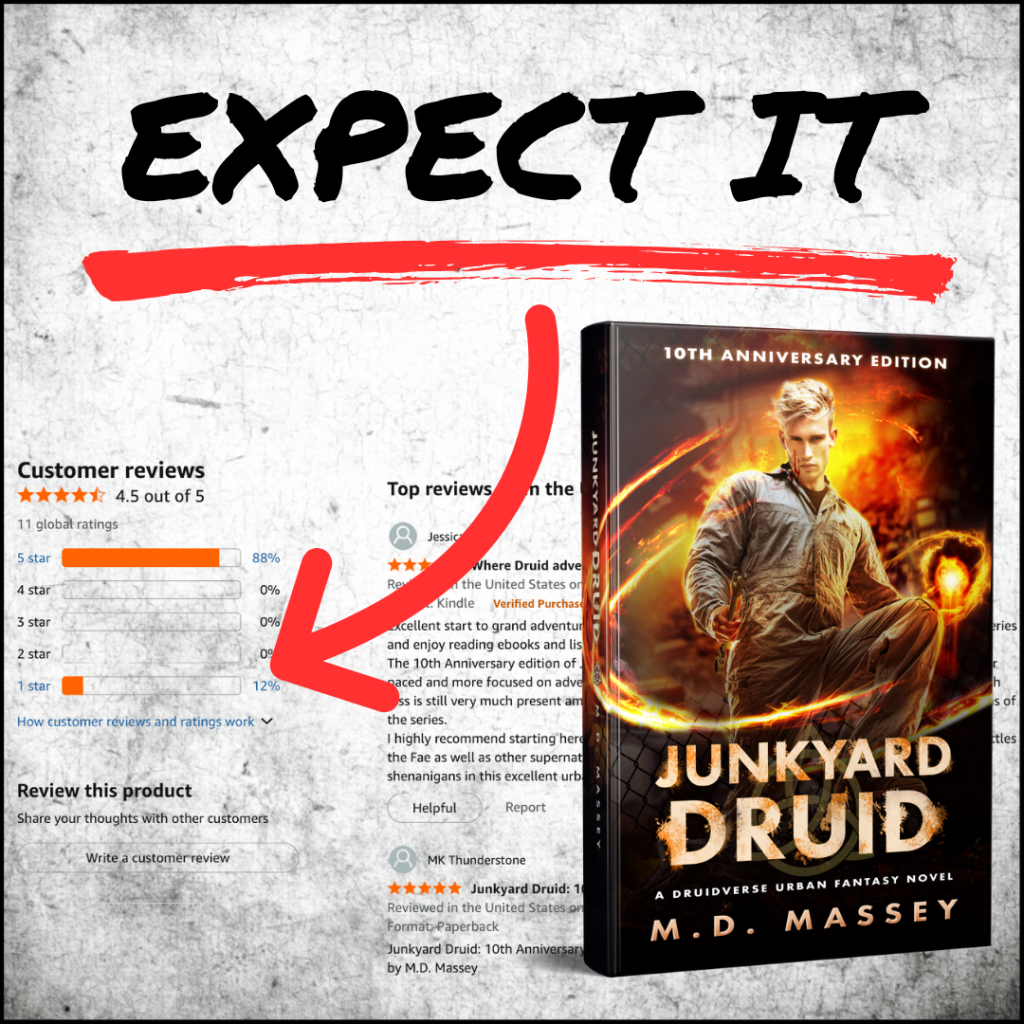
This is for aspiring authors who are wondering what to do when they get bad reviews of their novels.
See that one-star rating?
I guarantee it’s someone with an axe to grind.
Since I wrote Junkyard Druid, I’ve received a range of negative feedback on the novel from both sides of the aisle.
Some reviewers didn’t like Luther (“Omergerd, a gay character!”)
Others said Colin was a misogynist (I am not making that up—those loons tried to cancel me, unbeknownst to me).
Still others thought the humor was juvenile (TBF, much of it is).
And other readers complained that Colin was too whiny (a main subplot was about loss and grief, but they had a point).
Oh, and let’s not forget all the ‘this book is a rip-off of (Butcher/Hearne/insert random urban fantasy author)’ complaints. Initially, I received a ton of those sorts of reviews.
Become Immune, Not Oblivious
After writing fiction for over a decade, I’m pretty much immune to criticism at this point. Yet, I don’t totally discount it, as criticism from readers can be useful to a genre fiction author.
In my opinion, being a successful genre fiction author is all about meeting reader expectations.
Each genre follows certain conventions, tropes, and themes. Readers expect to encounter at least some of those story elements when they read a novel in their preferred genre, and rightly so.
That’s why I think authors shouldn’t totally discount poor reviews, as they sometimes contain hints regarding where an author might improve their writing.
Listening to Feedback
Thus, when I decided to revise Junkyard Druid for the 10th Anniversary Edition, I considered even my worst critics’ opinions when I revised and rewrote this novel.
I spent over a month going through it, paragraph by paragraph, and made sure the manuscript was clean and free from grammatical errors.
I improved the pacing and prose by removing parts that slowed the story, and I edited much of the dialogue to better foreshadow each character’s development later in the series.
My ARC readers loved it. They raved about how the novel had been vastly improved. Every review, a solid five stars.
In short, the novel is twice as good as it was when I first wrote it. Yet, someone obviously hated it.
Haters Gonna Hate
The truth is, this happens with every novel I write. I’ll receive glowing reviews from readers, and then, inevitably, someone will post a one-star rating.
These malcontents typically don’t even bother to leave a review. They’ll simply click the ‘rate this book’ feature on their eReader and give it a single star (why Amazon allows the rating system on the Kindle platform is beyond me, but so be it).
That’s the sort of feedback that isn’t useful to an author. It’s just someone who hates your work, which means it’s the sort of thing you ignore.
There’s nothing to be gained by mulling over one-star ratings. You’ll gain nothing by wondering why someone rated your book so low. It’s a waste of energy, with no useful information or data to be gained through examination.
Generally speaking, people who leave such reviews are misanthropes. They tend to be miserable, and therefore, they wish to spread their misery to as many others as possible. This makes their opinion not merely useless, but irrelevant.
Every Author Has Their Critics
The lesson here is that, no matter how good your work might be, how beloved it is among your readers, or how much you polish it, some random hater on the interwebs will give it a one-star rating.
That’s life as a writer. Even the most critically acclaimed authors have their detractors, and the bestselling authors are probably the most criticized.
And, listen—their reasons do not matter.
What to Do When Your Novels Get Poor Reviews
So, when you get reviews and ratings like this, don’t sweat it. It just means your book was read (or not read) by someone who isn’t in your target audience.
They are not one of your people.
Ignore it and move on.
You’re not writing for that person, anyway.
Instead, you’re writing for your target audience.
Those are the people you get up each day and hammer away at the keys for—the ones who vibe with your stories, characters, world, and voice.
Keep writing for them, ignore your vilest detractors, and be grateful for your dedicated readers.
Trust me, you’ll be a lot happier (and more successful) as an author after you internalize this lesson.
That’s all for today. Thanks for attending my TED Talk. 🙃
As a small business person I’d add, Don’t respond. It accomplishes nothing, makes you look defensive, and invites trolls.
Agreed. However, back when Amazon allowed you to respond to reviews, I knew an author who’d troll his trolls. Some of his responses were pretty funny.