
On Writing Fiction With AI
Every so often, some clown will accuse me of writing fiction with AI. While I have no idea if these people have read any of my work, I’m quite certain they understand very little about the current capabilities of AI writing tools.
AI tools simply can’t produce quality writing. In my opinion, they can’t help a fiction author write faster, either.
 Here’s why:
- AIs are shit at writing cohesive fiction narratives. That might change in the future, but for the moment AI fiction is horrendously bad.
- AIs often output nonsense, and they are prone to making mistakes. This means you have to spend a lot of time editing whatever your shiny new AI writing tool spat out. Editing takes time, and like most authors, I’d rather be writing.
- AIs lack the ability to create anything original. An AI can only take existing material and rearrange it to create pale imitations of the original piece. They never create anything new.
My apologies to all those would be authors out there who fell for some shyster’s ad on social media, promising that “…you too can become wealthy publishing books on Amazon using one simple AI tool!”
Sorry, it ain’t gonna happen, anymore than you’re going to get rich narrating fiction on Audible, or any of the other publishing “get rich quick” schemes currently being sold to an unsuspecting public.
That’s not to say I don’t use AI tools. I do occasionally use them for research, or when I’m looking for an obscure turn of phrase.
Unfortunately, AIs are also prone to hallucinations, so I have to doublecheck everything the AI tells me. With regards to AI being some sort of magical time saver, it’s generally a wash.
The bottom line? Currently, there’s simply no substitute for BiC time, which means “butt in chair.”
The Death of Art and Literature?
Yet, it is very likely that an AI will be able to convincingly emulate human-written fiction someday. In fact, at this very moment publishers are vying for the right to train AI “brains” on the books they’ve published.
Meaning, someday you’ll shop Amazon for a new novel and have no idea whether the books you’re browsing were written by a human or an AI.
If you want to know what that might look like, just take a look at the 23 million AI-generated images (and counting) on Adobe Stock. These AI images are said to be outperforming human-created artwork on the platform. Similarly, AI-generated music is said to be taking a sizable chunk of the royalty pool on Spotify.
Now, imagine if that were literature. Think about what it would be like if crappy, AI-generated books flooded Amazon.
Guess what? It’s already happened in non-fiction, and AI-genned fiction is slowly creeping into the genre fiction categories.
Most of these books are absolute crap, but it won’t always be that way. When you have companies like Google, Apple, Amazon, Sony, Microsoft, Meta, Adobe, IBM, and others actively seeking to develop AIs that can replace humans, change is inevitable.
What I fear the most is that AI will someday mean the death of human art and literature. Or if not the death, then surely the gradual decline.
Scary, right? I’m starting to think that the many worlds theory is real, and we’re living in the shittiest, most dystopian timeline ever.
My Take On Writing Fiction With AI
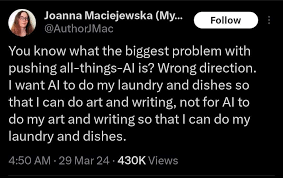 Honestly? It’s not for me.
I write for the sheer joy of it. Writing is my escape, my ritual, my freedom.
Sure, someday I might be able to train an AI language learning model on my books, then press a button and watch the AI shit out another book. But what would be the point?
In light of this, here’s my advice to you, dear reader:
Keep buying books from authors you know and trust.
Some of us are still interested in producing quality work, instead of making a fast buck by writing fiction with AI. So long as you keep buying the books we write, we’ll keep writing them.
As always, thanks for your support.
So here’s an interesting problem with AI writing, the Monkey selfie copyright dispute.
The result was that the US Copywrite Office stated that works made by a non-human are not copyrightable, so they are considered public domain.
Yeah, there are a ton of copyright issues there. I wonder if authors are even aware of what they’re doing to their rights when they “coauthor” a book with an AI. I will not even edit my work with an AI tool. No friggin’ way.
I write a lot of social media bios and letters for my clients. Recently, a long-term client and a friend asked me to review a letter she planned to use for marketing. It was bland and generic, and I did not wish to offend her as I didn’t know who had written it. I phoned and discussed it with her, explaining that it was so generic that anyone in her industry could put their name to it. It didn’t speak to her authenticity, which makes her so relatable to her clients. She gave an embarrassed laugh and told me that AI had written it. David Schoenbrun noted, “Although it is possible to teach Ai to mimic your personality, it will never truly be you.”
I agree, although we’ll see what happens over the next decade as the technology advances. I worry that at some point it’ll become so good at imitating human prose, there will be no way to distinguish what’s original and what’s derivative.